Selected S1 Survey Results

|

I have compiled some of the results from the survey last Thursday.  I hope you take the time to look through the aggregated data and my comments on it.  I want this data to be instructive and enlightening.  So, here we go!

1 - They don't make sense
4 - They make sense

For comparison, here is the grade breakdown of the class.


I find it interesting that many of you had a high estimation of your understanding of the basic concepts yet the course grades were so low by comparison.  Even more telling is the following breakdown of the final exam grades prior to the curve.


I am pointing this out because I think there is a slight disconnect between perceived understanding and actual performance in the class.  I think this misunderstanding is centered almost entirely around proofs and justification.  While many of you are capable of solving a given problem, you are unable to justify your work.  This may be for a multitude of reasons ranging from not knowing the theorems/postulates to being unable to separate what you are given from what you might know based on theorems/postulates.  Consequently, one of the major focuses of the second semester will be on the justification of your work.  Particularly the justification of work outside of the typical "two-column proof".
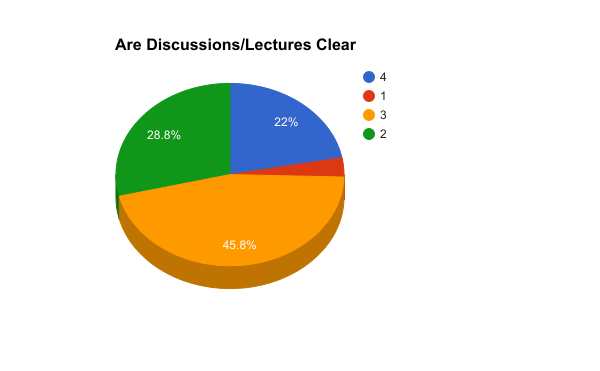
1 - Not clear
4 - Very clear

A large number of you said that lectures were somewhat not clear.  I find this surprising given the number of times per lecture that I ask for questions.  I cannot clarify what is not asked about.  It is a responsibility of the student to ask questions when the content is not clear.  


1 - Nope
4 - Yes!

This seems in line with the previous graph, so there's not much to say about it.  

1 - Never
4 - Often

Over half of you rarely or never review outside of class.  Reviewing your notes and examples can be extremely helpful if you are struggling with homework problems.  The materials you are creating should be a reference and your first line of defense when faced with a problem you aren't sure how to tackle.
1 - Never
4 - When I need it

As mentioned in class, tutoring is a critical part of the learning process if you find that you are stuck on problems or struggling with a concept.  22.9% of you claimed that you come see me frequently when you have a problem with the material.  That simply does not line up with the number of students that I have seen in tutoring over the course of the last semester.  Please take the time to address your issues prior to an assessment.  Coming in the day before or period before an exam is not generally a good tutoring model, as it encourages a short-term memory solution to your particular struggles.  

Geometry Semester 2 Survey

|

Please take a moment and fill out this survey to volunteer for class roles, express seating preferences, and vote on lecture styles.

Reminder to Unsubscribe

|

Hello subscribers old and new!  This is the last post for Semester 1 Discrete Math Students.  Thank you for a great semester and I hope you enjoy your semester of Business Statistics.  Don't forget to unsubscribe from the email alerts (unless you want to relive the memories).  See you at the Carnivale!

Semester 1 Reflection

|

Good morning!  On our last day of semester one, I wanted to take some time and reflect on the previous semester.  Please complete the following survey and then answer the reflection questions.  While your responses are not anonymous, as I need to know who has and who has not completed the survey, you will not be penalized for your opinions.  Please be honest, as that will be the most useful for both of us.

Semester 1 Reflection Survey

Semester 1 Reflection Questions

Answers to Review Materials

|

The answers to the practice test can be found here.

The answers to the review final are available here.

Semester 1 Review Material

|

Here is the review for Semester 1.

I also have a practice final.

Ch 3 Test Corrections

|

I am offering test corrections for the Chapter 3 Test.  These will need to be submitted to me by Monday (1/30) at the end of the day.  If I don't see you for a final on that day, you can find me in room 351 after school.  Below is the test correction procedure.  You must follow it to receive credit for your corrections.  Again, this must be submitted to me no later than end-of-day on Monday, 1/30, contrary to the time frame laid out for typical test corrections below.

Test Correction Procedure

You have one week to complete test corrections. The week begins on the day that your graded test is handed back to you. (Corrections will only be accepted for credit back on tests. You are still encouraged to make corrections on quizzes.)

You may get help from your classmates, parents, or teacher (before school, in the math lab during lunch, and after school). However, make sure you understand your errors enough to explain them clearly.

You must do the following on a piece of loose-leaf paper for each incorrect question or problem on the test:

  1. Number the problem/question and rewrite it.
  2. Write at least two complete sentences explaining what your error was and what you need to do to correct it. Write enough to prove that you understand it now. Include the type of error that you made.
  3. Show all work to correct the problem or question and include the right answer (make sure that the correct answer is clearly visible or circle it).

You can earn as much as half of the missed points back.

You will receive credit back if and only if the corrections that you made are correct.

You will receive a maximum of 1/2 credit back if you have 85% or better, 1/3 credit back if you have 70%-84.99%, and 1/4 back if you have 25%-69.99% in the homework category.

The original test MUST be turned in with the corrections.

You will need a parent or guardian signature on all tests and all test corrections.

Example Sentences:

“I made a mistake with exponent rules in the original expression. I should have added the exponents, but instead, I multiplied them. To fix this, I will have to use the product rule instead of the power rule.”

“My error was just a simple multiplication mistake. The volume for the cylinder that I found was twice as big as it should be because I accidentally multiplied the height and area of the base incorrectly. I wrote that 6x4 was 48. It was just an arithmetic mistake.”

Types of Errors

Computation Error

Adding, subtracting, multiplying, dividing, ect. incorrectly

Precision Error

Work too messy to understand | Dropping a negative sign | Forgetting parentheses | Missing units | Incorrect notation | Writing the wrong number | Not following directions

Problem Solving Error

Not following the rules of Algebra | Failure to complete all of the steps | Not showing thought process/work for each step

Conceptual Error

Not understanding the concept that is being tested